Introduction
Search no longer rewards patience. The moment Google can answer a question itself, it does, and the website that would have earned that click simply disappears from the equation. Most businesses are still optimizing for a search engine that worked one way, while Google has quietly started answering on their behalf in another. If your content isn’t built for that shift, you stop losing rankings and start losing customers who don’t even make it to your site, and that loss compounds with every passing month.
We built Cheenti Digital around solving exactly this problem, helping businesses get found inside the answers Google now writes itself.
This blog breaks down what’s actually changed in how Google surfaces information, why the old SEO playbook can’t keep up, and what specific moves protect your visibility right now.
We’ll cover content structure, technical optimization, authority signals, and how to measure success in a search landscape no longer solely in the shadow of the blue links.
Understanding Google AI Overviews and Generative Search
AI Overviews do not rank pages; they read them, extract facts, and rewrite the answer in Google’s own words first and foremost. The average AI Overview now includes nearly five source citations and reaches well over a billion users a month.
What most businesses miss is how unstable that citation list has become. Less than 40% of pages cited inside AI Overviews still rank in the traditional top 10, a sharp drop from previous years when that overlap was far higher. Being well ranked and being cited are now two different battles, and most companies are only fighting one of them, which is exactly why visibility keeps slipping even when rankings seem to be stable on paper.
If your page ranks #1 but isn’t written to be quoted, Google will skip it and cite someone else instead.
Why Traditional SEO Alone Is Not Enough in 2026
Backlinks and keyword density built the old internet. They don’t decide who gets cited in the new one, and businesses still relying on those old levers are watching their visibility erode without knowing why.
The Citation Shift Nobody’s Tracking
Pages that previously held positions 1 to 3 on now-AI-Overview queries are seeing organic clicks fall noticeably, even while still ranking exactly where they used to. The drop isn’t a penalty; it’s a redirection. Google is sitting on the answer and giving credit to sites whose content was structured clearly enough to be lifted directly into the summary.
| Ranks #1, Not Cited | Ranks #6, Gets Cited |
| Loses the click to the AI summary | Appears inside the answer itself |
| Treated as one of many sources | Treated as the source |
| Traffic depends on user scrolling past the answer | Traffic and brand recall happen before any scroll |
Why This Gap Keeps Widening
The companies that are behind aren’t creating bad content; they’re creating content for an algorithm that doesn’t make the decisions it used to. Without adaptation, that gap between visible and invisible just grows each quarter.
Create High-Quality Content That Answers User Questions
Generative systems aren’t about length; they’re about precision. The longer and more detailed your search query, the more likely you are to get an AI Overview. So the battle is being waged on the very questions your customers are asking.
Our content team builds every page around three habits: answering the core question within the opening lines of a section, supporting claims with verifiable data rather than broad claims, and keeping paragraphs short enough that both readers and crawlers can parse them without friction. If anything is written to “sound good” rather than to answer a specific question, it rarely gets cited, no matter how polished the language is.
Optimize Your Website for AEO and Generative Engine Optimization (GEO)
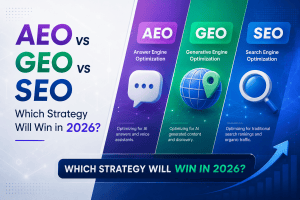
AEO and GEO shift the goal from ranking position to becoming the source Google’s models trust enough to quote directly, and that shift touches nearly every part of how a page gets built.
What We Build Into Every Client Site
- Schema markup that explicitly labels what a page answers, not just what it’s about.
- FAQ sections are phrased in the way people actually ask questions aloud.
- Fast, mobile-first pages, since most AI-driven queries happen on mobile.
- Clean, factual statements written in a form AI systems can lift word for word.
Why Owned Content Is Winning
Brand-owned websites now earn a meaningfully larger share of all AI Overview citations than they did just a year ago, which tells us directly that businesses investing in their own content are outpacing third-party aggregators that used to dominate these citations entirely.
Build Topical Authority and Strengthen E-E-A-T Signals
One good page doesn’t typically build trust by itself. Google’s generative models judge Experience, Expertise, Authoritativeness, and Trustworthiness across an entire topic before deciding who’s worth quoting, which means depth now beats isolated effort every time, and one strong article can’t make up for a thin overall presence.
We build that depth through connected content clusters around each service area, verified author credentials, and earned mentions from credible third-party sources, the same signals that separate a site Google trusts from one it merely tolerates.
Track Performance and Adapt Your SEO Strategy for AI Search
Rank tracking alone can’t tell you whether you’re actually winning anymore. We focus on AI citation frequency, branded search lift, and direct traffic shifts as our primary metrics, as pages cited within an AI Overview always see increased direct traffic and branded search, even on queries where raw clicks decline. Content freshness is important here too: pages that are left to sit for months are measurably more likely to lose their citation entirely. This isn’t a strategy you put together and walk away from; it needs to be revisited as Google’s models continue to evolve.
What Happens If You Wait
Every quarter spent optimizing for rankings alone is a quarter spent losing ground to competitors already structuring content for citation. AI overviews and generative search have permanently altered visibility, rewarding precise, well-sourced, authoritative content over mere ranking position. The strategies we’ll cover, from AEO-ready structure to topical authority, are no longer optional extras. They are what determine whether your business is mentioned by name or quietly left out of the answer altogether.
This is exactly the gap our SEO agency was built to close. As an expert SEO service, Cheenti Digital pairs experienced SEO consultants with proprietary tracking to make sure your content doesn’t just rank, it gets cited. We work with businesses across Dallas, Miami, Colorado Springs, Raleigh, San Diego, Los Angeles, California, New York, and North Carolina, alongside dedicated SEO services in Detroit and SEO services company in Washington, for clients who needed exactly this shift before their competitors made it first.
Waiting costs visibility you won’t easily win back. Call us today at +1 704 244 4192 and let’s make sure your business is the one Google chooses to cite.