Search has quietly crossed a tipping point.
People no longer search the internet the way they used to. Instead of typing fragmented keywords, users now ask complete questions. They speak to their phones. They expect instant, accurate answers—not a list of 10 blue links.
At the same time, search engines themselves are changing. With AI-driven experiences like Google’s Search Generative Experience (SGE) and conversational interfaces powered by large language models, search is evolving from ranking pages to delivering answers.
This shift is redefining how brands need to think about visibility. Traditional SEO still matters, but it is no longer enough on its own. What’s emerging is a smarter, intent-first approach that focuses on answers, context, and credibility.
Welcome to the era of AEO (Answer Engine Optimization), and the next chapter in the future of SEO 2025.
What Is AEO (Answer Engine Optimization)?
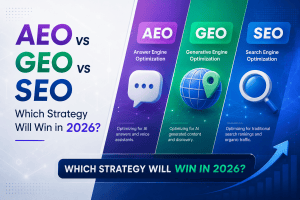
AEO (Answer Engine Optimization) is the practice of optimizing content so search engines can directly extract, understand, and present precise answers to user questions.
Unlike traditional SEO, which focuses on ranking pages, AEO focuses on:
- Answer clarity
- Contextual relevance
- Structured, machine-readable information
- User intent satisfaction
In simple terms, AEO ensures your content becomes the answer, not just another option.
SEO vs AEO: A Quick Comparison
| Aspect | Traditional SEO | AEO |
| Focus | Keywords & rankings | Questions & answers |
| Content Style | Long-form, keyword-heavy | Concise, intent-driven |
| Search Interface | Text-based SERPs | AI summaries, voice, chat |
| Success Metric | Page position | Answer visibility |
| User Experience | Click to read | Instant response |
This is why next-gen SEO techniques are increasingly blending SEO fundamentals with AEO frameworks.
How AI & SGE Are Reshaping Search
AI is no longer assisting search — it is search.
Google’s Search Generative Experience (SGE) and advancements like Google Gemini SEO are designed to synthesize information from multiple sources and present users with immediate, conversational answers.
What does this mean for brands?
- Fewer clicks, but higher-quality visibility
- Greater importance of authority and trust
- Content must be understandable to machines, not just humans
Key AI-Driven Search Shifts
- AI-generated summaries replacing traditional snippets
- Conversational follow-up queries are becoming common
- Increased reliance on AI-powered content optimization
- Higher penalties for vague, repetitive, or low-value content
In this environment, AI SEO strategies 2025 are less about gaming algorithms and more about earning relevance.
Why Traditional SEO Is Evolving (Not Disappearing)
Traditional SEO isn’t obsolete — it’s transforming.
Keyword research, on-page optimization, and backlinks still form the foundation. But search engines now evaluate how well content solves a problem, not just how well it matches a query.
What’s Changing
- Exact-match keywords matter less than intent
- Content depth matters more than content volume
- Trust signals outweigh technical tricks
- Engagement and clarity drive visibility
This evolution is why modern SEO trends prioritize user-first content supported by strong technical foundations, including schema and structured data, entity optimization, and semantic relevance.
Optimizing for Voice & Conversational Search
Voice assistants have trained users to ask questions naturally.
“Best SEO agency” has become
“Who offers expert SEO service for growing businesses?”
This shift has made conversational search optimization a critical part of SEO strategy.
Here’s something interesting:
As of 2025, around 20.5% of people worldwide actively use voice search — nearly 1 in 5 internet users — highlighting how conversational and voice-first queries are becoming mainstream.
Best Practices for Voice & Conversational Search
- Use natural, spoken language
- Answer questions directly and clearly
- Structure content in short, scannable sections
- Optimize for long-tail, question-based queries
- Focus on local and contextual relevance
Effective voice search SEO requires thinking like a human — not a crawler.
The Role of Structured Data & Schema
Search engines cannot assume meaning. They need signals.
This is where schema and structured data play a decisive role in AEO.
Structured data helps search engines understand:
- What your content represents
- Which answers are authoritative
- How information connects across entities
Benefits of Structured Data
| Benefit | Impact |
| Enhanced visibility | Rich results & AI summaries |
| Better context | Clear entity relationships |
| Improved accuracy | Fewer misinterpretations |
| Future readiness | AI-first indexing compatibility |
Structured data is no longer optional — it is foundational to SEO strategy for businesses aiming for long-term relevance.
Building Trust with EEAT
In an AI-driven search ecosystem, trust is currency.
Google evaluates content using EEAT and trust signals:
- Experience
- Expertise
- Authoritativeness
- Trustworthiness
AI models prioritize sources that demonstrate real-world knowledge, consistency, and credibility.
How Brands Can Strengthen EEAT
- Publish insight-driven, original content
- Demonstrate subject matter expertise
- Maintain transparency and accuracy
- Build consistent topical authority
- Avoid exaggerated or unsupported claims
Strong EEAT doesn’t just help rankings — it influences whether AI systems choose your content as a source.
Cheenti’s Perspective on Modern SEO
At this stage of search evolution, effective optimization requires balance.
A forward-thinking digital marketing agency like Cheenti Digital focuses on approaches that align SEO fundamentals with AEO readiness, focusing on intent, structure, and trust rather than surface-level tactics.
Modern SEO demands:
- Deep understanding of search behavior
- Intelligent use of SEO automation tools
- Strategic integration of AI in digital marketing
- Continuous refinement based on evolving algorithms
Rather than chasing trends, the emphasis is on building systems that adapt — a mindset that defines expert SEO service delivery today.
Preparing for the Future of Search
The future of SEO 2025 will not reward shortcuts.
Search will become more predictive, more conversational, and more selective in its sourcing. Brands that succeed will be those that invest early in:
- Answer-first content frameworks
- AI-compatible information architecture
- Scalable optimization strategies
- Trust-led digital presence
What Forward-Ready Brands Are Doing Today
- Mapping content to user intent, not keywords
- Structuring data for AI interpretation
- Optimizing for GEO and entity recognition
- Prioritizing clarity over content length
- Treating SEO as a long-term asset, not a tactic
This is the new definition of next-gen SEO techniques.
The Final Takeaway: Where Search Is Headed Next
Search is moving toward intelligence, context, and answers — and brands must move with it. Whether businesses operate in Dallas, Miami, Colorado Springs, Raleigh, San Diego, Los Angeles, California, New York, or North Carolina, the fundamentals remain the same: visibility now depends on clarity, credibility, and adaptability.
This is where strategic partners like Cheenti Digital step in — aligning SEO, AEO, and AI SEO strategies 2025 into a cohesive approach built for evolving search ecosystems. For brands looking to future-proof their digital presence, now is the moment to rethink optimization — not as a checklist, but as a long-term growth strategy.
Ready to align your brand with the future of search?
Explore how Cheenti Digital can help you navigate modern SEO with precision, insight, and measurable impact.